Onboarding That Adapts to Skill Level
Traditional onboarding slows productivity and increases error risk. Discover how AI-native adaptive execution systems personalize guidance and accelerate time-to-competency on the shop floor.
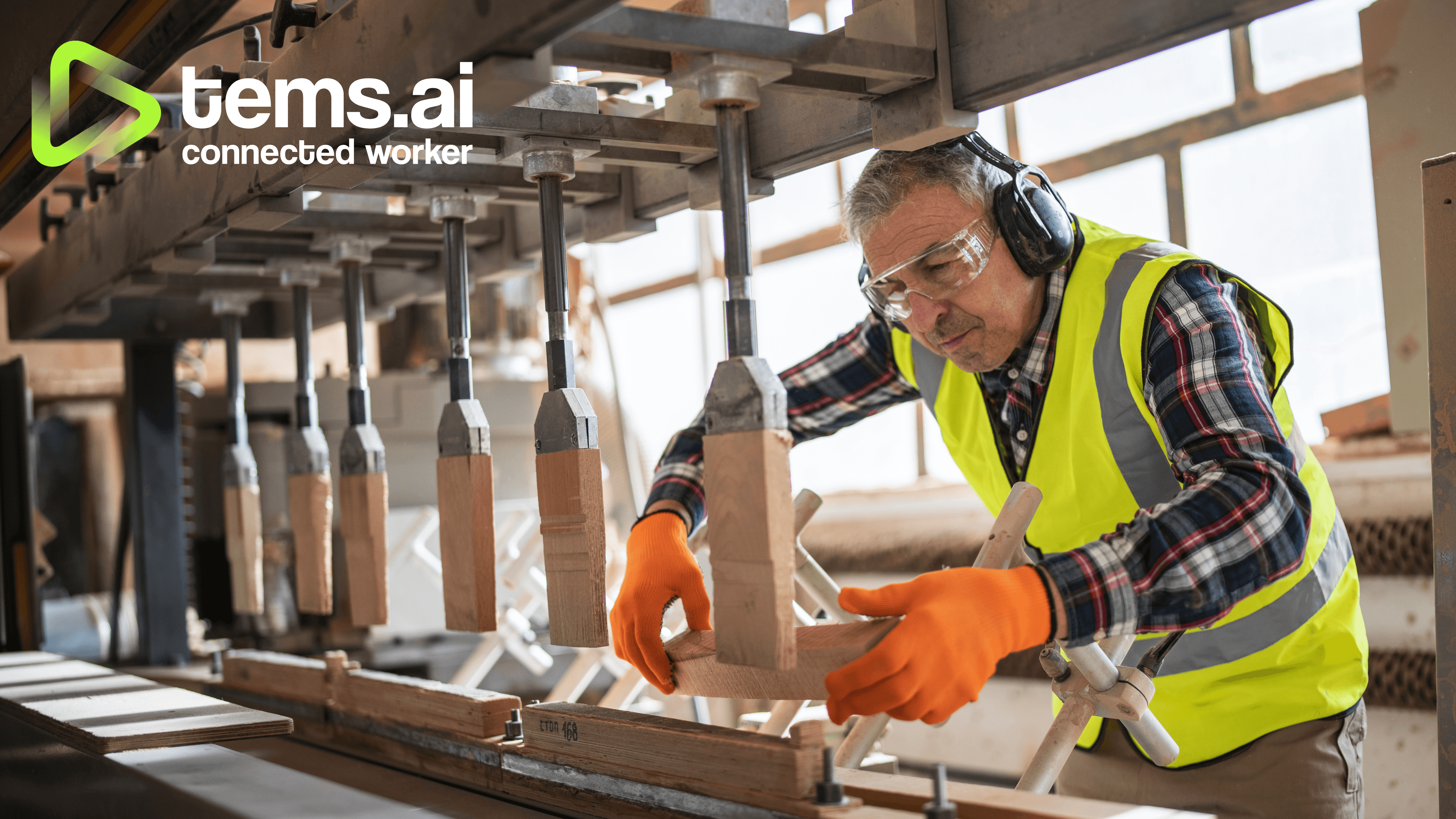
How AI Compresses Time-to-Competency in Manufacturing
Meta Title
AI Manufacturing Onboarding | Adaptive Training & Faster Ramp-Up | TEMS.AI
Meta Description
Traditional onboarding slows productivity and increases error risk. Discover how AI-native adaptive execution systems personalize guidance and accelerate time-to-competency on the shop floor.
URL Slug
ai-adaptive-onboarding-manufacturing
Introduction: The True Cost of Slow Ramp-Up
Manufacturing faces a structural workforce shift:
- Aging operators retiring
- Skilled labor shortages
- Higher turnover
- Cross-training under pressure
Every new hire represents:
- Training investment
- Reduced short-term productivity
- Increased supervision load
- Elevated error probability
Traditional onboarding models struggle to scale.
The question is not how to train more.
It is how to compress expertise.
Why Traditional Onboarding Fails in Modern Plants
Conventional onboarding typically includes:
- Classroom sessions
- LMS modules
- Shadowing experienced operators
- Gradual task exposure
These methods assume:
- Stable processes
- Repetitive tasks
- Ample mentorship capacity
Modern manufacturing is:
- High-mix
- Fast-paced
- Data-intensive
- Highly regulated
The gap between training and execution widens.
The Problem of Uniform Training
Most onboarding assumes uniform learning speed.
In reality, new hires differ in:
- Prior experience
- Technical aptitude
- Language proficiency
- Confidence under pressure
Uniform modules produce uneven performance.
Some feel overwhelmed.
Others feel constrained.
AI-native systems adapt in real time.
Adaptive Onboarding Defined
Adaptive onboarding means:
The system dynamically adjusts:
- Instruction depth
- Pace of guidance
- Frequency of prompts
- Escalation thresholds
Based on:
- Observed task performance
- Error frequency
- Stabilization speed
- Intervention patterns
Onboarding aligns with individual capability.
Learning During Execution, Not Before It
Traditional onboarding separates learning from doing.
AI-native execution embeds learning inside production.
Instead of:
Train → Certify → Execute
The flow becomes:
Execute → Guide → Adjust → Improve continuously
Operators learn in context.
Retention increases.
Example: Changeover Training
A new operator assigned to changeovers may struggle with:
- Parameter sequencing
- SKU-specific nuances
- Verification steps
AI-native onboarding:
- Provides step-by-step contextual prompts
- Highlights risk-critical steps
- Detects hesitation patterns
- Reinforces high-variance tasks
As performance improves, guidance gradually reduces.
Confidence builds without compromising quality.
Reducing Early-Stage Error Risk
New hires are statistically more likely to cause:
- Setup errors
- Missed inspections
- Minor stoppages
- Safety oversights
AI-native adaptive systems:
- Trigger additional verification during early shifts
- Provide real-time micro-coaching
- Escalate if abnormal patterns persist
Error curves flatten faster.
Time-to-Competency Compression
Time-to-competency includes:
- Achieving stable cycle time
- Maintaining quality standards
- Executing independently
- Responding to deviations correctly
AI-native onboarding reduces:
- Ramp-up duration
- Supervision intensity
- Rework frequency
Manufacturers report significantly faster performance stabilization when contextual guidance is embedded in execution.
Skill Telemetry Integration
Adaptive onboarding links directly with skill telemetry:
- Execution data informs skill progression
- Intervention frequency indicates learning curve
- Stabilization speed signals competency maturity
This replaces subjective assessment with data-backed insight.
Promotion and task assignment become evidence-based.
Multilingual and Cognitive Adaptation
Manufacturing workforces are often diverse.
AI-native platforms can:
- Present instructions in multiple languages
- Use visual and interactive guidance
- Adjust complexity of information
- Reduce text density when needed
Accessibility improves inclusion and performance.
Safety During Onboarding
New operators are more exposed to safety risk.
Adaptive systems reinforce:
- Mandatory safety checkpoints
- Risk-triggered prompts
- Escalation pathways
Safety compliance becomes embedded in learning process.
Financial Impact of Adaptive Onboarding
Slow onboarding increases:
- Labor cost per unit
- Scrap during early shifts
- Supervision overhead
- Downtime during learning curve
Faster competency yields:
- Higher productivity
- Lower rework
- Reduced overtime
- Improved OEE stability
Onboarding transforms from cost center to capacity enabler.
Cultural Impact
New hires often experience anxiety during early shifts.
AI-native onboarding provides:
- Clear next-step guidance
- Reduced uncertainty
- Immediate feedback
- Structured support
Confidence increases.
Retention improves.
Integrating Onboarding with Standard Work
Adaptive onboarding connects with:
- Self-learning standard work (Article 10)
- Skill telemetry (Article 9)
- Digital travelers (Article 23)
Learning and execution become unified.
Procedures evolve based on real onboarding performance.
Enterprise Deployment Strategy
Phase 1:
Digitize high-risk workflows.
Phase 2:
Enable adaptive guidance for new operators.
Phase 3:
Integrate skill telemetry and escalation logic.
Phase 4:
Standardize across multi-site network.
Measured rollout ensures ROI visibility.
Strategic Questions for Leaders
- How long does it take new hires to operate independently?
- What percentage of scrap occurs during early shifts?
- How much supervision time is required per new operator?
- Are onboarding progress metrics objective or subjective?
If onboarding duration is unpredictable, adaptive intelligence is required.
The Strategic Advantage
In labor-constrained markets, the ability to ramp talent quickly is a competitive differentiator.
Plants that compress expertise:
- Scale faster
- Adapt to demand shifts
- Reduce dependency on long-tenure operators
- Stabilize performance across shifts
Adaptive onboarding strengthens operational resilience.
Conclusion: Learning Must Be Embedded
Manufacturing complexity will not simplify.
Workforce variability will continue.
Static onboarding models cannot keep pace.
AI-native adaptive execution systems:
- Personalize guidance
- Compress learning curves
- Protect safety
- Stabilize quality
Onboarding stops being a hurdle.
It becomes acceleration infrastructure.
Frequently Asked Questions
What is adaptive onboarding in manufacturing?
Adaptive onboarding uses AI to adjust instruction depth and pace based on real-time operator performance data.
How does AI reduce time-to-competency?
AI provides contextual guidance during execution, reducing errors and accelerating stabilization.
Can adaptive onboarding improve safety?
Yes. AI reinforces safety checkpoints and escalates abnormal behavior during early shifts.
How is onboarding performance measured objectively?
Through skill telemetry metrics such as stabilization time, intervention frequency, and error patterns.
Is adaptive onboarding scalable across sites?
Yes. AI-native platforms standardize onboarding workflows while adapting to local execution conditions.
Ready to transform your operations?
Book a 30-minute demoRelated articles
Connected Worker 2.0: Why "Another App" Won't Fix Your Factory
Discover why first-generation connected worker apps failed and how AI-native edge platforms transform shop-floor execution, OEE, and quality performance.
Best Practices for Digital Forms and Checklists in Manufacturing
Digital forms and checklists standardize work and capture data in real time. Discover best practices for implementing them effectively on the manufacturing shop floor.
Time Studies Without Stopwatches
Traditional time studies interrupt production and rely on manual observation. Discover how AI-native edge systems measure task duration and bottlenecks automatically in real time.